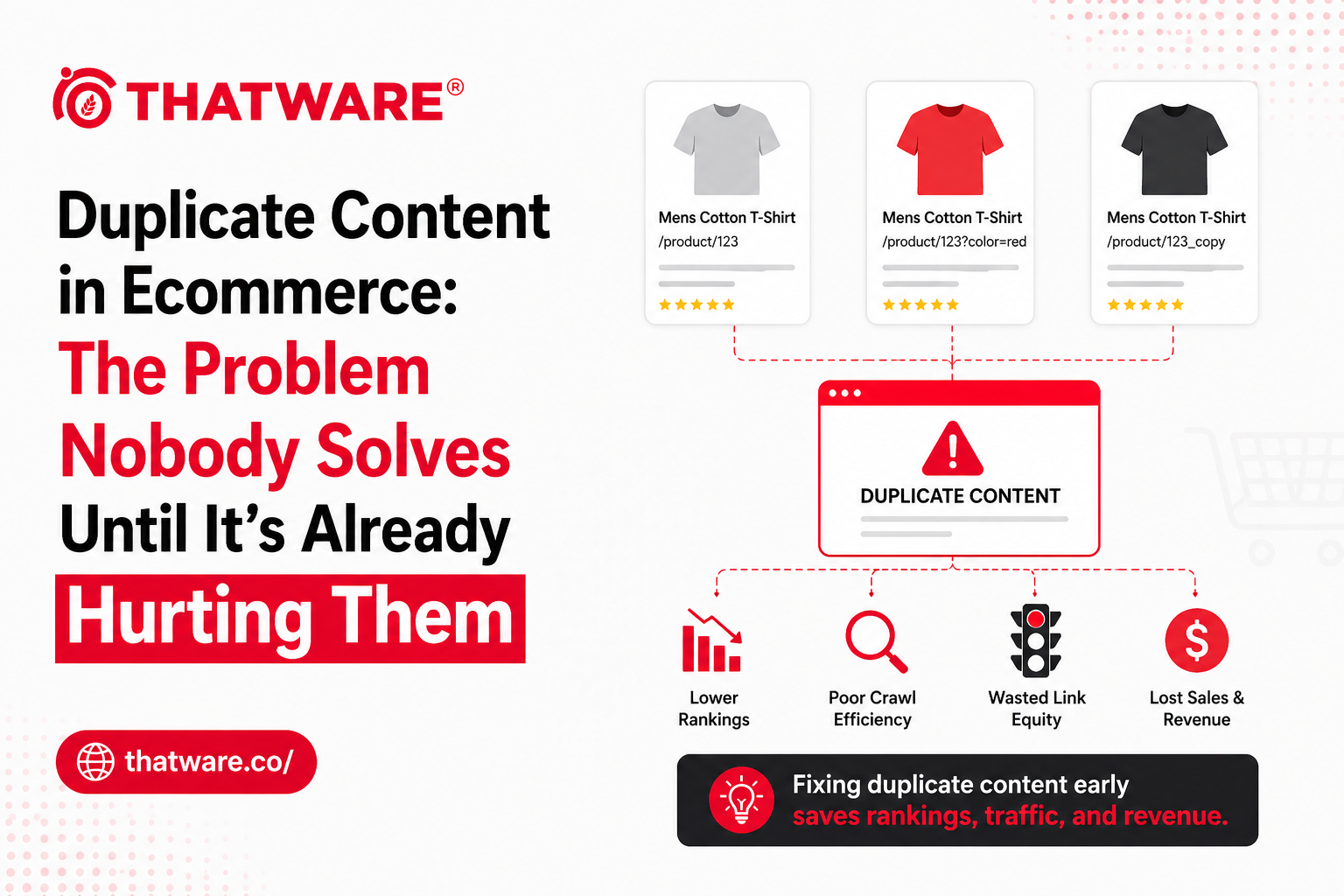
Here’s the thing about duplicate content in e-commerce: by the time most brands realize they have a serious problem, the problem has been quietly suppressing organic performance for months or years. It doesn’t announce itself with a penalty notice or a dramatic traffic drop. It just silently limits how well your pages rank, creates indexation confusion that means the wrong pages compete for the same queries, and dilutes the authority that should be concentrated on your most important pages.
Most e-commerce sites have duplicate content issues. Not as a theoretical edge case — as a structural reality of how product catalogs, faceted navigation, and pagination work. The question isn’t whether your e-commerce site has duplicate content problems; it’s how severe they are, where they’re concentrated, and whether they’re being managed or not.
How Duplicate Content Happens at Scale
The mechanisms that create duplicate content in e-commerce are mostly built into how the platforms work, not the result of careless decisions.
Faceted navigation is the biggest source. When a user can filter a product category by size, color, brand, price, and multiple other attributes, each unique filter combination generates a different URL — often with identical or near-identical content. A category page for “women’s running shoes” might generate hundreds of URL variants: /womens-running-shoes/size-8, /womens-running-shoes/color-blue, /womens-running-shoes/brand-nike/color-blue/size-8, and so on. Most of these pages have no unique content and should never be indexed.
Pagination creates similar issues. /products/page-2, /products/page-3 — paginated versions of category pages often have substantially similar meta data and structure to page-1, and without explicit handling, search engines may treat them as competing pages for the same queries.
Product variant pages are another common source. A product available in ten colors and six sizes could technically have 60 URL variants — each with the same product description, often with only the product image changed. Whether these should be separate URLs or handled as variants of a single URL is a decision that significantly affects duplicate content risk.
Sorting functionality adds more: /products?sort=price-low-to-high, /products?sort=newest — these URL parameters create additional near-duplicate pages that don’t need to be indexed.
Why It Quietly Limits Performance
The effect of unmanaged duplicate content on e-commerce SEO plays out in a few specific ways.
Crawl budget dilution. Search engine crawlers have a finite amount of crawl capacity they’ll invest in any given site. A large e-commerce site with thousands of duplicate URLs from faceted navigation is spending a disproportionate share of its crawl budget on pages that shouldn’t be indexed, at the expense of pages that should. The result: important product and category pages get crawled less frequently, updates take longer to index, and new pages appear in search results more slowly.
Ranking signal dilution. When multiple URLs contain the same or substantially similar content, ranking signals — links, engagement metrics — are split across those URLs rather than concentrated on a single canonical page. This dilutes the authority of the pages that should be ranking, making them weaker competitors than they would be if the duplicate variants were correctly handled.
Index quality problems. Google’s index includes only a fraction of the URLs it discovers — pages that don’t meet quality thresholds are excluded or deprioritized. A site with large numbers of thin, duplicate pages has an index quality problem that affects how its better pages are evaluated relative to competitors.
The Technical Solutions That Actually Work
Ecommerce seo services addressing duplicate content at scale typically involve a combination of technical approaches, each appropriate for different situations.
Canonical tags tell search engines which version of a page is the authoritative one when multiple URLs contain the same content. Faceted navigation variants can point back to the clean category URL. Pagination can be handled with self-referencing canonicals or canonical chains. Sorting parameter URLs can all point back to the default sort. Implemented correctly, canonical tags concentrate ranking signals and prevent competing versions from splitting authority.
Robots.txt parameter handling tells search crawlers not to follow URLs with certain parameters at all. For parameters that clearly generate pages with no unique value — most sorting and display options — blocking crawling entirely is appropriate and effective. The distinction between this and canonical tags: robots.txt prevents crawling, while canonicals influence indexing decisions for already-crawled pages.
URL structure choices for new platform implementations or significant migrations can eliminate duplicate content risks architecturally. Building faceted navigation to not generate indexable URLs by default — using JavaScript state management or hash-based URLs that don’t create new indexable pages — is cleaner than retroactively managing thousands of already-indexed duplicate URLs.
Product Description Uniqueness at Scale
Beyond navigation-generated duplicates, ecommerce seo agency work frequently encounters another duplicate content source: manufacturer product descriptions used across multiple retailers.
When fifty different online retailers are using the same manufacturer-provided product copy for the same SKUs, none of them has unique content. None of them has anything that differentiates their page from the other forty-nine. Google either picks one to rank (usually based on domain authority, effectively meaning that small retailers don’t rank for their own product pages) or ranks none of them well for non-branded queries.
The solution is genuinely unique product content — written by people who know the products, reflecting customer language and actual use cases, addressing the questions real buyers have. This is harder and more expensive than publishing manufacturer copy. It’s also one of the clearest paths to ranking for product-level keywords against larger competitors who can’t be bothered to write unique descriptions for every SKU.
For large catalogs, this doesn’t mean writing custom descriptions for every single product. It means identifying the products where organic search traffic is most valuable, prioritizing those for unique content investment, and building a systematic approach to expanding coverage over time.
Auditing and Prioritizing What to Fix
An effective duplicate content audit for e-commerce doesn’t just catalog every duplicate URL — it prioritizes the issues by SEO impact and fix complexity.
High-impact, low-complexity fixes: incorrect canonical implementations that can be corrected in site configuration. Parameter handling that can be addressed in Search Console. These should move immediately.
High-impact, moderate-complexity fixes: faceted navigation URL architecture changes that require platform configuration but don’t involve structural redesign. Pagination canonicalization. These are high-value enough to prioritize in the next development cycle.
Lower-impact or high-complexity fixes: complete platform architecture changes for URL structure. These are worth planning for major site updates rather than forcing as immediate remediation.
The discipline is in the prioritization. Every e-commerce site has a longer list of duplicate content issues than it can fix immediately. Working through them systematically — highest-impact first — produces faster visible improvement than attempting everything at once and getting bogged down in complexity.