When planning a badminton court, whether for a school, academy, residential complex, or public sports facility, the first and most important step is getting the court size and layout right. Many badminton courts fail not because of poor play, but because dimensions, spacing, and flooring choices were misunderstood at the construction stage.
This guide explains standard badminton court size in feet and meters, correct layout planning, and how those measurements directly affect badminton flooring, surface material selection, and construction cost—especially for synthetic badminton courts.
Official Standard Badminton Court Dimensions
Badminton court dimensions are governed internationally by the Badminton World Federation (BWF). These standards apply to both indoor and outdoor synthetic badminton courts, with minor construction considerations based on exposure and usage.
Court Size for Doubles Play
- Length: 44 feet (13.40 meters)
- Width: 20 feet (6.10 meters)
Court Size for Singles Play
- Length: 44 feet (13.40 meters)
- Width: 17 feet (5.18 meters)
A properly marked doubles court can also be used for singles by adjusting the side boundary lines.
Total Area Required (Including Safety Zones)
While the playing area is fixed, badminton court construction details must include safety run-off zones:
- Minimum recommended playing + safety area: 59 ft × 29.5 ft (approx.)
- This spacing is essential for:
- Player safety
- Smooth footwork
- Long-term performance of badminton flooring material
- Player safety
Ignoring safety clearance often leads to edge damage in badminton court synthetic flooring.
Badminton Court Layout & Line Markings
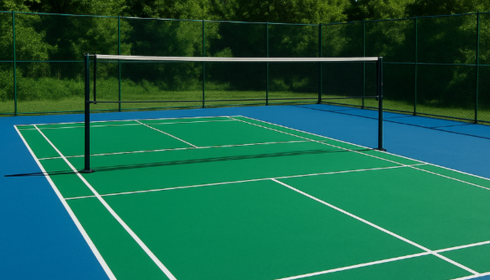
Correct line marking is just as important as size. Standard markings include:
- Center line
- Short service line
- Long service line (singles & doubles)
- Side lines for singles and doubles
- Net line at center (net height: 1.55 m at posts, 1.524 m at center)
All markings should be done using compatible synthetic court line paint, integrated into the badminton court surface material, not applied as ordinary paint.
Choosing the Right Badminton Court Surface Material
Why Synthetic Flooring Is Preferred
Modern courts increasingly use synthetic badminton court flooring instead of tiles, concrete paint, or wooden substitutes—especially in Indian conditions.
Synthetic flooring for badminton court offers:
- Controlled grip (anti-skid texture)
- Consistent shuttle bounce
- Lower joint stress
- Better durability than conventional badminton floor material
This makes it ideal for:
- Academies
- Schools
- Clubs
- Outdoor badminton court flooring projects
Indoor vs Outdoor Badminton Court Flooring
Indoor Courts
- Often installed over a concrete base
- Use synthetic badminton flooring with a smoother texture.
- Cost depends on:
- Cushion layers
- Shock absorption requirement
- Ventilation & hall height
- Cushion layers
The cost of construction of an indoor badminton court varies based on system thickness and finish quality.
Outdoor Courts
- Require UV-resistant and water-resistant coatings
- Must handle heat, rain, and surface expansion
- Use specialized outdoor badminton court flooring systems.
For outdoor installations, badminton outdoor court flooring must be designed to drain surface water properly and prevent peeling.
Outdoor Badminton Court Construction Details
For a durable outdoor synthetic badminton court, the following are critical:
- Proper concrete base with slope (not flat casting)
- Full curing before flooring application
- Acrylic primer and resurfacer layers
- Textured color coats for grip
- Accurate line marking integration
Skipping any step impacts performance and raises future maintenance and resurfacing costs.
Badminton Court Construction Cost Overview
Outdoor Badminton Court Construction Cost
The outdoor badminton court construction cost depends on:
- Base condition
- Acrylic system type
- Area size
- Number of layers
Synthetic Badminton Court Pricing
Common search queries include:
- Badminton synthetic court price
- synthetic badminton court price
- synthetic court badminton price
- synthetic court price
Prices vary based on:
- Cushion vs non-cushion systems
- Thickness of acrylic layers
- Usage intensity (training vs competition)
A quality badminton court synthetic system always costs less over time due to lower repairs and longer resurfacing cycles.
Why Court Size Impacts Flooring Performance
Incorrect dimensions lead to:
- Uneven wear zones
- Edge cracking
- Reduced the life of badminton flooring material
- Increased resurfacing frequency
That’s why badminton court size, layout, and flooring must be planned together, not separately.
Why choose AQS
AQS specializes in synthetic badminton court flooring systems designed around correct court dimensions, base behavior, and long-term surface performance. Instead of treating size, layout, and flooring as separate steps, AQS approaches badminton court construction as a complete system—ensuring accurate measurements, compatible surface materials, and durable execution suited to Indian playing and climate conditions. This integrated approach helps reduce premature wear, resurfacing frequency, and long-term maintenance costs.
Final Thoughts
Understanding standard badminton court size in feet and meters is only half the job. The real success of a court lies in how well those dimensions are supported by the right badminton flooring, correct surface material, and proper construction execution.
Whether planning an indoor academy court or an outdoor synthetic badminton court, investing in the right layout and flooring system ensures:
- Player safety
- Consistent play
- Long-term cost efficiency